

Inside India’s infrastructure revolution
India’s infrastructure transformation is driving economic growth, digital connectivity and investment, laying the foundation for long-term competitiveness and innovation.

India’s infrastructure transformation is driving economic growth, digital connectivity and investment, laying the foundation for long-term competitiveness and innovation.

A look at how the growing fragmentation of the global digital economy could disrupt connectivity, trade, innovation and inclusive digital growth.

An exploration of how technology, education, business, and institutions are reshaping economies and influencing India’s path toward global economic growth.

Generative AI is transforming election misinformation through realistic synthetic media. It discusses how AI-powered disinformation is creating new challenges for election integrity and public trust.

Bhaskar Chakravorti explains how “small AI” differs from “big AI” and why accessible, affordable AI could help developing economies unlock new opportunities for inclusive growth and digital transformation.

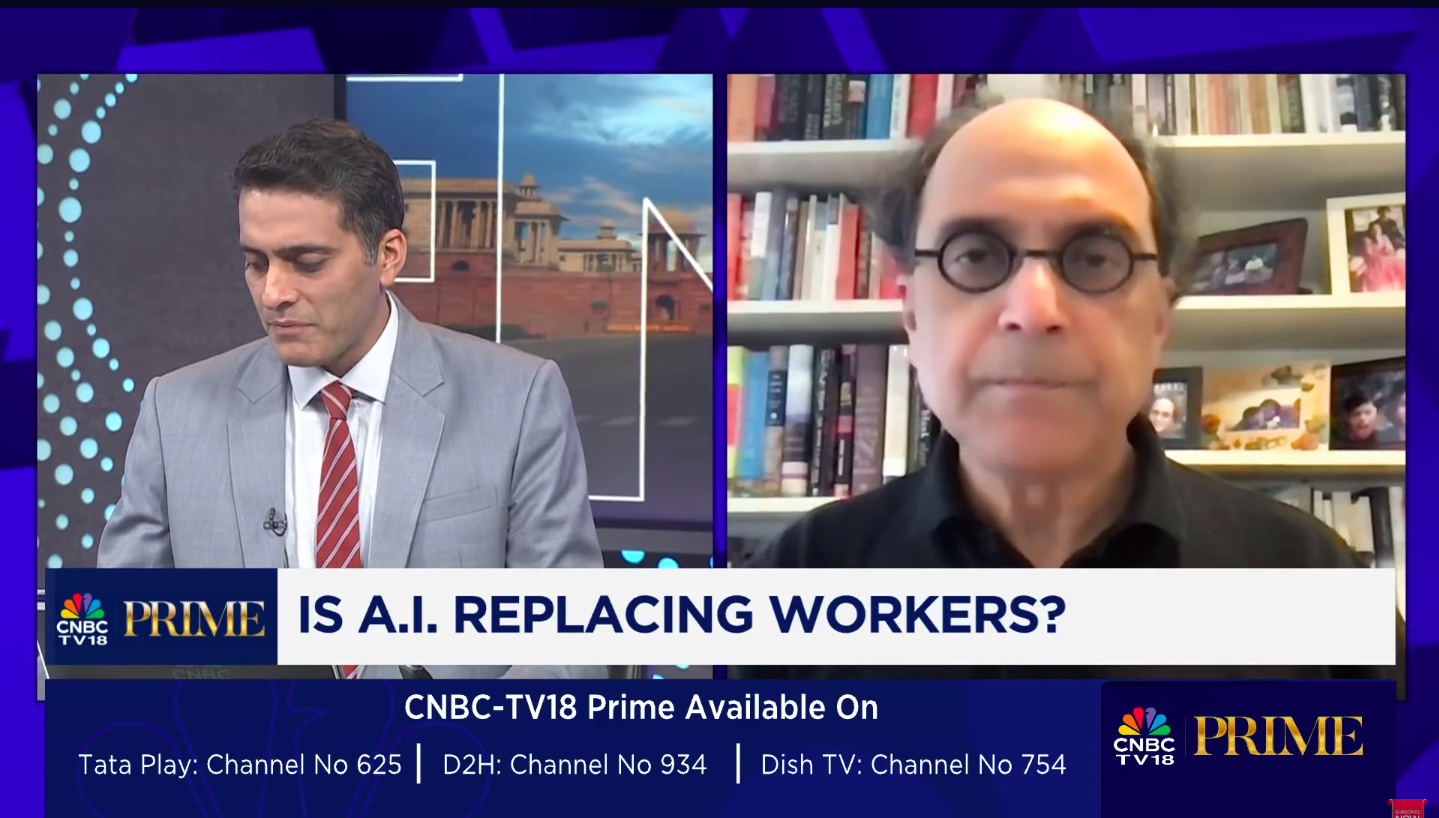
AI is disrupting jobs at a pace that traditional upskilling programs cannot match. In this CNBC interview, Bhaskar Chakravorti explores why governments and businesses must rethink workforce development, social safety nets, and public policy to prepare for the rapid transformation of the AI-driven economy.

As AI transforms knowledge work, its impact is extending beyond the workplace into politics. Growing concerns over job displacement and economic insecurity among white-collar workers are reshaping voter sentiment, highlighting how AI-driven disruption could influence future political and policy debates.

A new report estimates that over 9 million U.S. jobs are vulnerable to AI-driven disruption, underscoring how automation is reshaping tasks, industries, and the future of work.

As AI adoption accelerates, public concern is rising over its impact on jobs, skills, and the future of work. A new poll reveals growing public anxiety over AI’s impact on jobs, as experts warn that millions of roles across sectors such as technology, finance, and professional services could face disruption.

The AI boom is driving unprecedented investment, but questions remain about whether future revenues can support the scale of spending required to sustain it.

Prediction markets are reshaping how information, forecasting, and public sentiment are aggregated, creating new regulatory challenges for policymakers worldwide.

Surrounding AI valuations and public offerings, it highlights the overlooked markets, infrastructure, and applications that could drive the next wave of digital transformation.

As digital markets become increasingly fragmented by geopolitics, regulation, and technological competition, the analysis explores how businesses and nations can adapt to a rapidly evolving global economy.

Growing concerns around AI-driven disruption in entry-level work, echoing broader research on how automation is reshaping career pathways, workforce readiness, and the future of knowledge-economy jobs.

AI Jobs Risk Index warns that 9.3 million U.S. jobs could be vulnerable to AI-driven automation, with potential income losses ranging up to $200 billion. The analysis highlights how high-skill white-collar roles are increasingly exposed as AI reshapes the modern workforce.

AI automation is being compared to the “China shock,” with white-collar urban centers identified as the next major zones of economic disruption. The analysis explores how this shift could reshape jobs, cities, and income patterns across the U.S.

AI-driven job disruption is emerging as a new political force in America’s “Wired Belt.” The analysis explores how white-collar AI displacement could reshape voter behavior, influence future elections, and redefine the nation’s political landscape.

Ghana’s national AI strategy sets out an ambitious 10-year roadmap to drive inclusive growth, aiming to significantly boost the economy while transforming key sectors through investments in skills, infrastructure, data, and innovation.

AI exposure is highest in Massachusetts, where data- and knowledge-driven jobs face growing risk of displacement, signaling broader disruption across advanced, innovation-focused economies.

AI could displace over 200,000 jobs in the Boston area and 260,000 statewide, highlighting how knowledge-based roles in coding, writing, and data analysis are increasingly vulnerable—putting innovation hubs at the center of workforce disruption.

Massachusetts emerges as the most exposed U.S. state to AI job disruption, highlighting how tech-driven economies and high-skill roles face growing risk of displacement and income loss.

Massachusetts faces the highest AI job disruption risk in the U.S., with over 260,000 roles and $25 billion in income at stake, highlighting how high-skill, knowledge-driven economies are increasingly vulnerable to automation.

A high-stakes Federal Reserve leadership bid brings renewed focus on central bank independence, political pressure, and the challenges of managing inflation amid global economic uncertainty.

Boston stands at the center of AI-driven job disruption, with over 200,000 roles at risk and billions in wages exposed, highlighting the growing impact of automation on knowledge economies in the U.S.

Will AI trigger the next Great Displacement? Bhaskar Chakravorti explores how “Wired Belt” knowledge workers in swing states could drive a massive political revolt as AI disrupts white-collar industries.

Digital Planet Chair Bhaskar Chakravorti sits down for a candid chat with the Indianness Podcast, recounting his academic journey, his learnings from global businesses and leaders, and, most importantly, the impact of Artificial Intelligence when it can be funnelled into solutions for every citizen

A closer look at the white-collar roles most vulnerable to AI disruption, and how the resulting job losses could reshape major U.S. cities, states, and knowledge-driven economies over the next five years.

Beyond moral panic, AI offers both risk and augmentation. India must map the “topography” of job vulnerability to navigate this historic shift in the labor market.

Fletcher’s Digital Planet at Tufts University has launched the American AI Jobs Risk Index, data-driven report that maps how AI could impact jobs across occupations, industries, cities, and states in the U.S.

From vulnerable data centers to rising energy costs, the Iran war is revealing the structural fragilities that could finally pop the AI industry bubble.

AI’s growth story is now facing its biggest stress test: geopolitical conflict, chip supply vulnerabilities, and rising market speculation are turning bubble fears into a serious economic risk.

Combining critical thinking with AI literacy is the key to securing future roles, according to Tufts Dean Bhaskar Chakravorti in the new AI Jobs Risk Index.

A new study warns 9 million U.S. jobs face AI displacement by 2031. See the American AI Jobs Risk Index list of the most—and least—vulnerable occupations.

The “Wired Belts” are the new Rust Belts. A Tufts study warns 9.3M jobs and $757B in income are at risk from AI. See if your city or career is on the danger list.

New study predicts AI could displace 9 million US workers in 5 years. Discover which 33 “tipping point” jobs are most at risk and how to stay ahead of the bots.

Digital Planet’s AI Jobs Risk Index provides a data-driven map of U.S. job displacement. Discover the 33 “tipping point” occupations most at risk from AI tools.

Digital Planet Chair Bhaskar Chakravorti decodes the implications of these dynamics by drawing attention to historic crises that emerged because of a lack of purposeful direction and uncontrolled spending.

Tufts University’s new American AI Jobs Risk Index reveals up to 9.3 million US jobs face displacement, with high-skill knowledge workers in major tech hubs most at risk.

Digital Planet Chair Bhaskar Chakravorti sits down for a candid chat with the Indianness Podcast, recounting his academic journey, his learnings from global businesses and leaders, and, most importantly, the impact of Artificial Intelligence when it can be funnelled into solutions for every citizen

The article outlines India’s push for human-centric AI frameworks that balance innovation with workforce readiness and social impact.

Bhaskar Chakravorti shares the stage at the India AI Impact Summit 2026 to discuss the future of AI literacy in India.

Explore how India can win the AI race by prioritizing social welfare over power, using purpose-driven tech to transform farming and healthcare.

The boom makes it hard for competitors to step away from a treadmill of continuous acceleration.

Tech leaders say systems now rival human intelligence in key tasks, further fuelling the superintelligence debate

Microsoft, Alphabet, Meta, and Amazon are investing tens of billions in data centers. AI infrastructure is now a key driver of US economic growth.

The AI bubble may be inflated by fear and hype — but real change is coming. The questions are: are tech companies ready, can the economy sustain the spending, and how will we measure value?

The obsession with powerful large language models overlooks the developing world.